

An Article by Helen Alexiou.
December, for me, seems to be a schizophrenic mix between festive spirit and closing-time pressure. With most eyes being either on deadlines or on holidays (if your eyes are simultaneously on both, you are my people), the Cyclades may not be on our minds. Yet, during the winter calm, a planning revolution is underway. The Special Urban Plans (EPS) for Santorini and Mykonos are nearly here — and if you’ve ever dreamed of developing on these islands, now is the time to take notice.
If you’ve been following our legal briefings, you know that I’m a sucker for greenfield developments. And while the news I relayed above might be conceived as upsetting, in my mind it means there’s light at the end of the proverbial tunnel.
Let me explain: I recently heard from an official source of the Ministry of Environment that, outside Attica, 75% of land in Greece remains unregulated. Meaning, there is no comprehensive planning regime that applies. Meaning that development is not feasible in ¾ of the rest of Greece, under Article 24 of the Constitution, as interpreted by the Council of State.
As if this were not enough to block projects, a special set of restrictions apply to small islands, especially the Cyclades which are considered as sensitive ecosystems that require special attention and protection. Now bear in mind, this principle was brought forward by the Council of State as early as the 80s (!), but has recently come back with a vengeance, mainly because the government has failed to take measures in time.
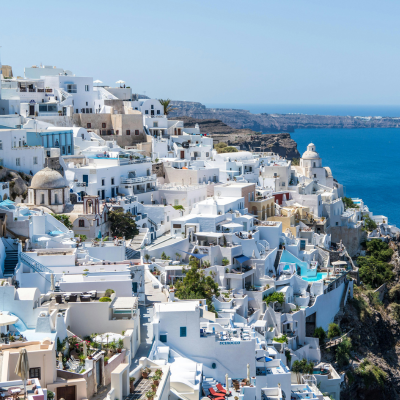
Historically, both Mykonos and Santorini have experienced decades of intense building activity, impacting their natural and cultural landscapes. I believe quite a few of you may have seen videos of the infamous Caldera swamped with tourists who are clapping (yes, that’s not a typo) at the sunset. Others may have flown over Mykonos, which is so densely built, it looks like Thessaloniki. (I am tempted to include links to videos and photos, but I am fighting the urge –you can chatgpt it).
Over the past decade, we’ve had investors ask us for assistance in hospitality developments on both islands, for obvious reasons. My response has remained — pretty much— the same: we need to respect the carrying capacity, a vague, insufficiently regulated notion. What these two EPSs will bring is exactly this: an assessment of the current status of the islands, including their carrying capacity, and of what can realistically be developed without overwhelming the islands’ natural and cultural heritage. In other words, the EPSs are finally putting a framework around what has been largely unregulated for decades, giving investors a clearer picture of where development is feasible — and where it isn’t.
Running late but finally on their way, the new Special Urban Plans for both islands are expected to reach the Council of State next spring for their usual “normative scrutiny” — the Court’s legal once-over before the plans can be enacted as presidential decrees. Early indications suggest that these EPSs will tighten building rules considerably, effectively redrawing the development map of the Cyclades.
Starting with Santorini, already one of the most densely built islands in the Mediterranean relative to its size, the EPS will introduce more restrictive zoning: protection zones would expand to roughly 66% of the island (up from 28%), while development areas shrink to 33% (down from 71%). Perhaps the most eye-catching change is the minimum plot size for tourism facilities, rising to 40,000 sqm (4 hectares) — well above current standards.
On Mykonos, the EPS is a bit gentler. A single tourism–recreation–holiday housing zone is proposed in the south, while the rest of the island (about 70%) would be largely protected, promoting milder or alternative tourism. Plot sizes for tourism facilities would increase to 30,000 sqm (up from ~10,000 sqm), while holiday homes would require plots of at least 8,000 sqm (up from 4,000 sqm) with a maximum building allowance of 200 sqm per plot. Primary residences are the exception, maintaining the 4,000 sqm minimum to protect the locals’ needs.
And it doesn’t stop with Santorini and Mykonos. The Western Cyclades — Kythnos, Serifos, Sifnos, Kimolos, and Milos — are next in line, with their EPS expected to reach local authorities soon. With so many plans in the pipeline, though, the Council of State may take several years to complete its normative scrutiny (but this is a problem for another time).
Why does this matter? Because for decades, much of Greece has been essentially flying blind when it comes to planning, leaving development legally risky and often impossible under Article 24 of the Constitution. So, while the new EPSs might initially sound restrictive — and yes, some plot sizes are bigger, and protection zones have expanded — the reality is actually quite encouraging. For the first time (in, like, ever) investors and developers will have clarity: a framework that defines what can be built, where, and under which conditions.
Bottom line: these EPSs are the long-overdue wake-up call the Cyclades needed — finally balancing preservation with actual development. They take on board the Carrying Capacity Assessment, nod to Council of State rulings, and protect the islands’ stunning landscapes — all while keeping genuine opportunities for building alive. For anyone like me who’s been screaming about the need for clarity for years, this is basically the closest thing to a legal roadmap we’ve seen in decades.
Ok, on Santorini and Mykonos, investors will need bigger plots and will face expanded protection zones. But think of this as a makeover — not a clampdown. The Cyclades are finally getting the planning tools they’ve been missing for decades, and anyone with an interest in these islands can now see the boundaries, the opportunities, and the rules of the game.
On a more personal note, it feels almost surreal to see it finally coming together. I still have my doubts and I’m still conscious of the enormous burden that will fall — once again— on the Council of State.
Buckle up, Cyclades — your construction cones are out, your signs are up, and your future is starting to take shape.